
A Batch Manufacturing Record (BMR) is the complete set of instructions, data, and evidence generated during the production of a single batch. It captures everything from raw-material weighing and equipment use to in-process checks, deviations, and final release — making it the authoritative record of how a batch was actually made.
In regulated industries such as pharmaceuticals, biotechnology, and medical devices, the BMR is a GxP document. It must be accurate, contemporaneous, attributable, legible, complete, and available for review by quality assurance and inspectors.
Batch Manufacturing Record definition
The simplest Batch Manufacturing Record definition is: a controlled document that records the manufacturing history of one batch. It proves that each step was performed according to the approved instructions and that the batch meets its quality specifications before release.
A typical BMR includes:
- Batch number, product code, and manufacturing date
- Bill of materials and component traceability
- Equipment and line used, with cleaning and setup checks
- Step-by-step operator instructions and confirmations
- In-process control results and signature records
- Any deviations, investigations, and corrective actions
- Final yield, reconciliation, and quality-release decision
Medical devices: device manufacturers keep equivalent production records for each device or batch. In the US these were traditionally called the Device History Record (DHR). Since FDA's Quality Management System Regulation (QMSR) took effect on 2 February 2026, the requirements follow ISO 13485:2016 and production records sit within the Medical Device File. The principles in this guide still apply: an approved master, an executed record per batch, and traceable review and release.
Master Production Record (MPR) vs. Batch Manufacturing Record (BMR)
The Master Production Record (MPR) is the approved template: it defines how the product should be made. The BMR is the instance record: it shows how one specific batch was made.
| Master Production Record (MPR) | Batch Manufacturing Record (BMR) |
|---|---|
| The approved, generic recipe | The executed record for one batch |
| Defines materials, steps, and parameters | Captures actual values, times, and signatures |
| Changes require formal change control | Deviations are recorded and investigated |
Think of the MPR as the sheet music and the BMR as the recording of a single performance. Both are needed to demonstrate compliance and drive continuous improvement.
BMR terminology: the same record under different names
| Term | Where you'll see it |
|---|---|
| Batch Production Record (BPR) / "batch production and control records" | US FDA, 21 CFR 211.188 |
| Master Production Record (MPR) / "master production and control records" | US FDA, 21 CFR 211.186 |
| Master Batch Record (MBR) | Common industry synonym for the MPR |
| Batch Processing Record and Batch Packaging Record | EU GMP Chapter 4 (sections 4.20 and 4.21). The EU separates manufacturing and packaging records |
| Batch Manufacturing Record (BMR) | Common UK, EU and international usage |
| eBR / eBMR | Electronic versions of any of the above |
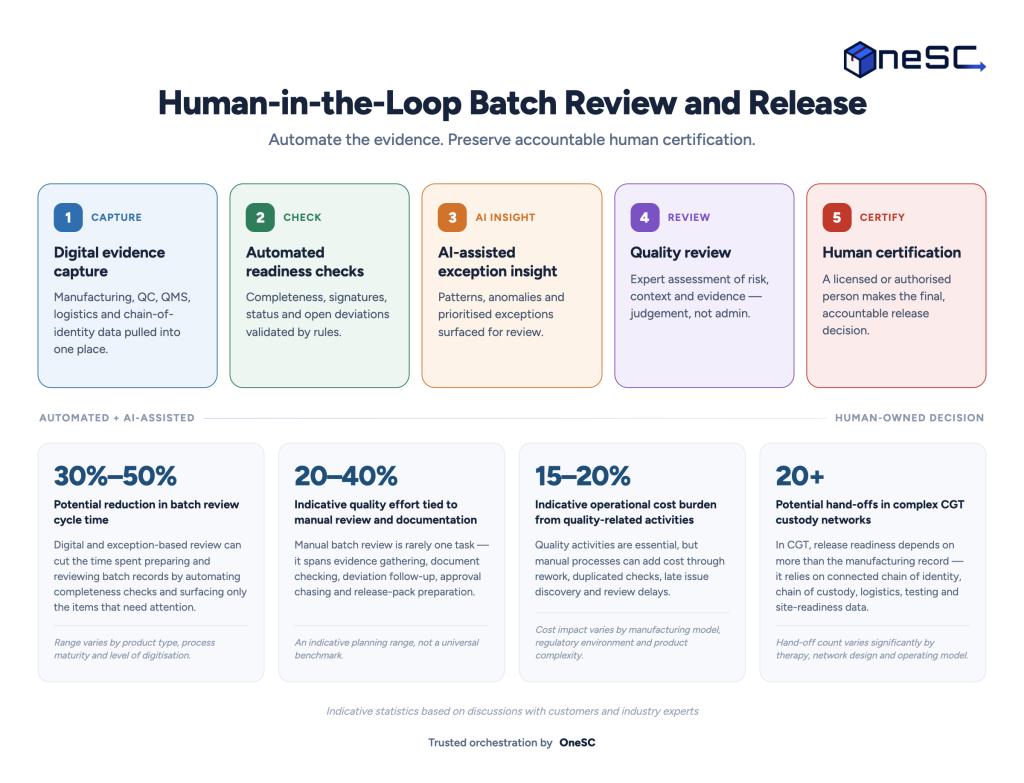
From paper BMR to electronic batch record (eBMR)
Traditionally, BMRs were paper packets passed from operator to quality reviewer. Paper is familiar, but it creates friction: manual transcription errors, missing signatures, slow review cycles, and limited visibility into batch status.
An electronic batch record (eBMR) digitises the same workflow. Operators follow guided instructions on a screen, data is captured automatically from instruments and MES, and the system enforces rules before the next step can proceed.
Benefits of moving to eBMR
- Faster batch review and release cycles
- Fewer transcription and signature errors
- Real-time visibility into batch status across sites
- Automated deviation routing and CAPA integration
- Complete audit trail with electronic signatures
- Reduced paper storage and archive costs
Regulatory context: GMP, electronic records, and data integrity
Electronic batch records in pharmaceuticals must meet the same data-integrity requirements as paper records. Global regulators expect electronic records and signatures to be trustworthy, with 21 CFR Part 11, EU GMP Annex 11, the MHRA GxP Data Integrity Guidance and PIC/S PI 041 setting the baseline for many jurisdictions.
Key requirements include:
- Validation: systems must be validated for their intended use
- Audit trails: secure, computer-generated, time-stamped records of changes
- Access control: unique user IDs, role-based permissions, and password policies
- Electronic signatures: under 21 CFR Part 11, FDA treats electronic signatures as equivalent to handwritten signatures when the Part 11 controls are in place: unique signer identity, the signature linked to its record, and the meaning of the signature (for example "reviewed" or "approved") displayed. EU GMP Annex 11 sets equivalent expectations in the EU and UK.
- Data integrity: ALCOA+ principles — attributable, legible, contemporaneous, original, accurate, plus complete, consistent, enduring, and available
Best practices for BMR design and digitisation
Whether you are writing a BMR for the first time or migrating hundreds of paper records to eBMR, the following practices reduce risk and improve adoption:
- Start with the MPR: make sure the master recipe is clear, accurate, and under change control before creating batch records.
- Design for the operator: present one step at a time, use plain language, and avoid unnecessary free-text fields.
- Build in checks: use range checks, forced comments, and signature gates to catch errors at the point of entry.
- Connect systems: integrate with ERP for materials, MES for execution, and QMS/LIMS for quality and lab data.
- Plan the audit trail: decide early what events to log and how long to retain records.
- Train and validate: train users on the new process and run parallel batches before go-live.
Reviewing CMO batch records without drowning in PDFs
If you outsource manufacturing, the BMR isn't executed in your systems. It is executed at your contract manufacturer and arrives as a scanned or exported PDF packet. You still own the release decision, so your QA team has to:
- chase executed records and supporting documents from each CMO
- check them against your approved master and specifications
- track deviations and queries raised with the CMO until they are closed
- pull in CoAs and lab results before the QP or QA can release the batch
For a virtual or outsourcing pharma company, this usually means email threads, shared drives and a spreadsheet tracking which batch is where. You can't see what's blocking release, and there's no single audit-ready history.
Where OneSC fits: OneSC is not an eBMR execution system and does not replace your CMO's MES. It is the orchestration layer above them. It brings each batch's records, deviations, lab results and approvals into one governed batch thread, so your team can see review status across every CMO and release faster with a complete, traceable record.
In practice
A UK virtual pharma company uses OneSC to manage batch documentation across its outsourced supply chain.
Across customers: release cycles up to 25% shorter, with first value in 4 weeks.
Common BMR challenges and how to solve them
Even with an eBMR system, manufacturers often struggle with fragmented data. ERP holds the order, MES holds the execution data, QMS holds deviations, and LIMS holds test results. Without a control layer, teams spend hours reconciling spreadsheets to understand batch status.
OneSC addresses this by orchestrating the full batch lifecycle across ERP, MES, QMS, and LIMS. Instead of chasing data across systems, quality and operations teams see a single, governed batch thread from order to release.
What OneSC does
- Batch orchestration across ERP, MES, QMS, and LIMS
- GxP-ready workflows with electronic signatures
- Real-time dashboards and audit-ready reporting
- Deviation management and CAPA integration
Frequently asked questions
What is the difference between a BMR and a batch record?
The terms are often used interchangeably. Strictly speaking, the Batch Manufacturing Record is the controlled document that captures the manufacturing history of a specific batch, while "batch record" can also refer to the broader set of supporting records such as lab notebooks and logbooks.
Is an eBMR the same as an MES?
No. An MES runs production on the shop floor, and many MES platforms include eBMR functionality for executing batches. But most batches pass through several systems before release: ERP for orders and materials, QMS for deviations, LIMS for test results, and often a CMO's own systems. OneSC sits above these as an orchestration layer, so quality teams see one batch thread from order to release, whether or not they run an MES themselves.
How long should batch records be retained?
It depends on the market and product type:
- United States: batch production, control and distribution records must be kept for at least one year after the batch's expiration date. Certain OTC products without expiry dating are kept for three years after distribution (21 CFR 211.180(a)).
- EU and UK: batch documentation must be kept for one year after the batch's expiry or at least five years after certification by the Qualified Person, whichever is longer. For investigational medicinal products, it is at least five years after the last clinical trial using the batch is completed or formally discontinued (EudraLex Volume 4, Chapter 4).
If you supply several markets, apply the longest applicable period. Records supporting the marketing authorisation, such as validation and stability data, may need to be kept for as long as the authorisation is valid.
Sources and further reading
- US FDA — 21 CFR Part 211, Subpart J: Records and Reports (211.180, 211.186, 211.188)
- US FDA — 21 CFR Part 11: Electronic Records; Electronic Signatures
- US FDA — 21 CFR Part 820: Quality Management System Regulation (QMSR)
- European Commission — EudraLex Volume 4: EU GMP Guidelines (Chapter 4 Documentation; Annex 11 Computerised Systems)
- MHRA — 'GXP' Data Integrity Guidance and Definitions (Revision 1, March 2018)
- PIC/S — PI 041: Good Practices for Data Management and Integrity in Regulated GMP/GDP Environments
Regulatory references checked October 2026. Always confirm against the current version of the applicable regulation.